
OF The Opinion Series – Episode One – Wojciech Wegrzynski: “OFR was the First To Do This at Scale”
OF the Opinion is a series of essays from our colleagues, clients, and collaborators. This year, as we celebrate 10 years of OFR Consultants, we’re showcasing a diverse mix of voices, each reflecting on their work and memories with us.
We kick off the series with Wojciech Węgrzyński, host of the OFR-sponsored Fire Science Show podcast, a fire-safety engineer and Professor at the Building Research Institute (ITB) in Warsaw, and Deputy Head of the Fire Research Department.
Wojciech has collaborated with OFR on productive research and investigations – even when challenges like Covid, complex collaborations, and consignment issues have tested the team…
“The team at OFR is a rare group. They approach things differently and have been trailblazing in their field for a long time.
I have been fortunate to know the team for more than a decade, even longer if you count my student years following the work of Dr. Mike Spearpoint, who I consider a personal hero. As a smoke control engineer, the work of Mike and Roger Harrison, who is also at OFR today, are foundational to whatever I am doing today.
It was not until the mid-2010s, however, that I became more closely acquainted with his colleague, Dr. Danny Hopkin. I cannot pinpoint the exact moment we met, but our paths crossed online and at various events and we soon connected. I knew we would be able to achieve something meaningful together.
Committed Collaborations
Since then, we have been fortunate to collaborate several times on research that has been conducted in a rigorous and authentic way. Our collaborations focus on advancing knowledge and breaking boundaries. This approach is unique and forms a core part of OFR’s identity.
When Danny joined OFR, the company was still very small, but the commitment to research was evident from the start. He was not there only in a commercial capacity; he and OFR genuinely wanted to undertake research.
In the early years, our work focused on timber, particularly CLT and engineered timber. At that time, there was little scientific rigor in the marketing of timber with research really only going as far as fire resistance of certain elements and not getting the full story.
OFR then joined the Structural Timber Association partnership in the UK, proposing game-changing experiments to help the industry gain a thorough understanding of timber. I was over the moon to be a part of such a large experimental programme and to grab a chance to really collaborate with OFR.
Science for Good
This milestone project was unique because it was not commercially driven. The motivation and driver behind it came from the construction industry which wanted and needed change to better understand the materials it used.
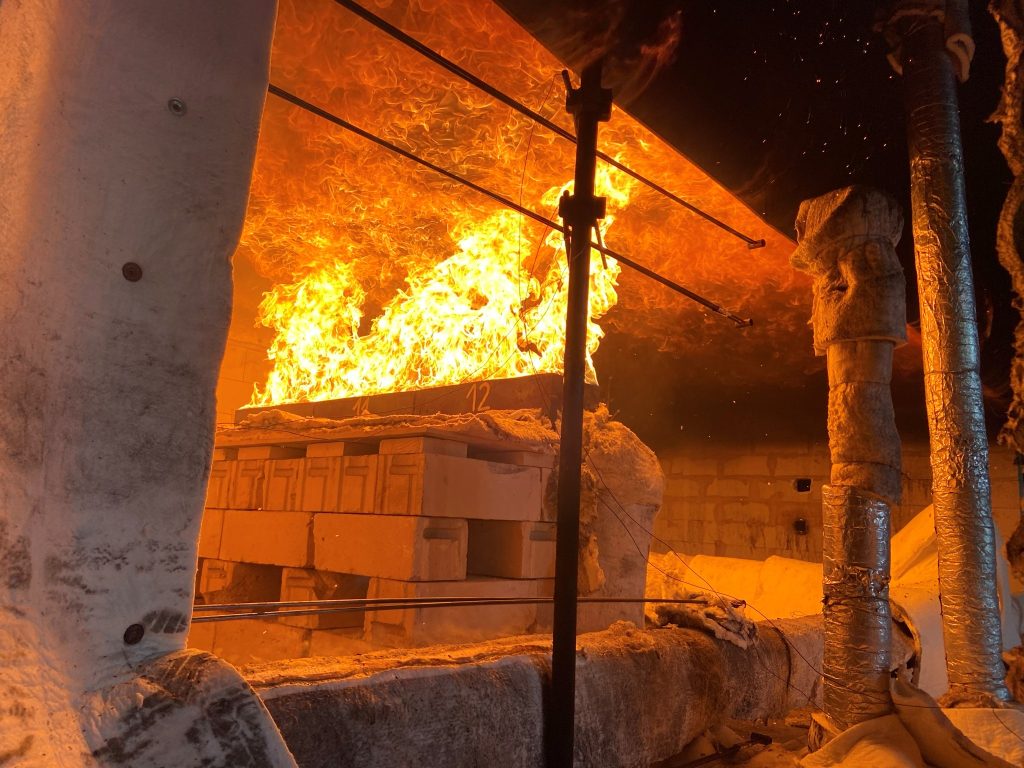
Our experiments would help them with this, going far beyond standard fire laboratory methods by exploring the fundamental physics of fire, predicting material behaviour, and testing early modelling.
Our experiment was well-engineered with a hypothesis set from the start. We also designed a rig that had never been built before, allowing us to assess independent elements of a structure and make detailed predictions about material combustion – things like the ceiling which was literally independent from the compartment. This scale of experiment was unique then and remains rare today, making the findings highly significant and allowing us to generate intricate data around things like the rate at which timber was burning.
These early experiences make me proud, especially when I see our work cited in widely published papers like the UK Commercial Timber Handbook. It was one of the most complex pieces of research I have ever conducted, but it motivated us to continue and undertake further studies, and I hope it provided the industry with valuable data and insights.
Challenges and Calamities
It has not always been smooth, and we have sometimes created additional challenges for ourselves, resulting in memorable stories.
In 2022 for example, materials for an experiment were sent to the wrong location. The shipment, 23 tonnes of timber, arrived at our headquarters building in downtown Warsaw, just next to the Ministry of Defence. I happened to be there (a lucky coincidence) and had to negotiate with the driver as he attempted to manoeuvre his truck away from the Ministry, being chased by soldiers with long guns. The soldiers were not pleased; the driver was pretty brave, though.
I then had to inform the driver that his hefty consignment of timber actually needed to reach our laboratory 100 km away. He then told me he could not move until he received confirmation from the sender in the UK – simple you’d think, but dear reader, this shipment date coincided with Queen Elizabeth II’s funeral, so colleagues in the UK were off work!
We managed to resolve it by getting hold of the supplier in Austria, but it is certainly a story for the anniversary memory book!
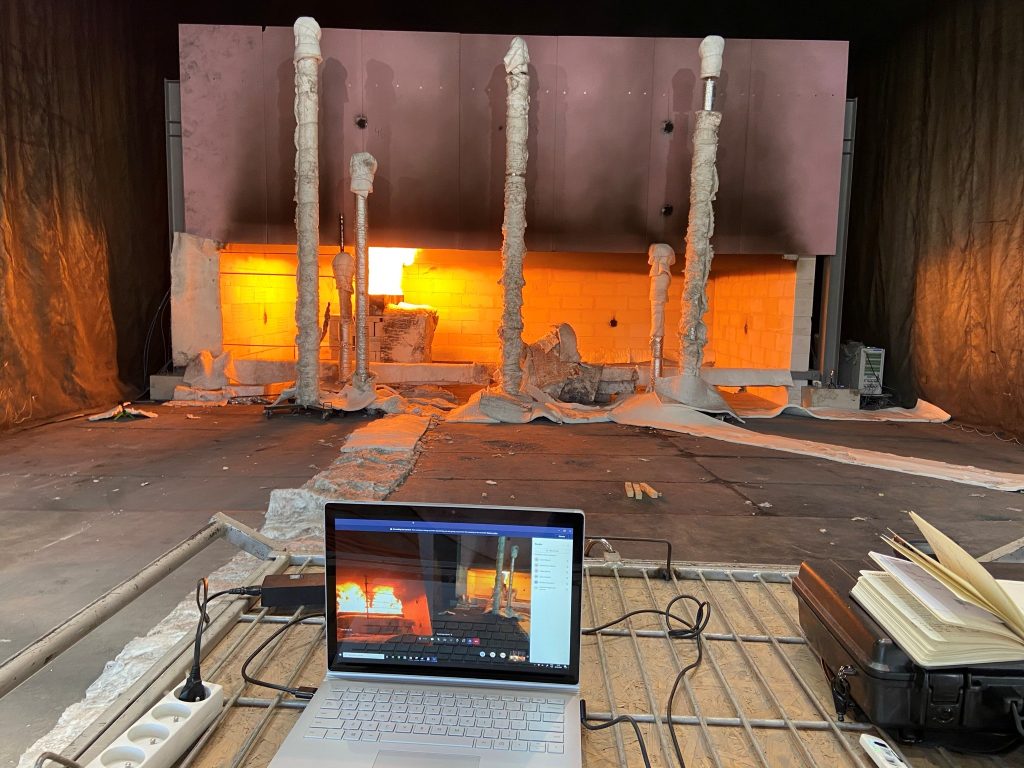
Another anecdote is what the English may call “watching paint dry” and comes from the COVID period. I spent long hours in the lab – with Danny, Mike, and their colleagues on Teams, observing experiments including CLT buildings with thick layers of encapsulation. Hours of heating them up..While the observation required extended calls, it allowed detailed and prolonged study. To manage the boredom, we spent the time discussing fire science and generating new ideas so it left me with fond memories of what were generally not the most exciting events.
Despite these challenges, the experience with OFR has always been enjoyable, impactful and crucially we’ve always come away with learnings, working together to adjust parameters and adjust our thinking. One thing that is always a part of those collaborations is their impact – they always touch important, timely and challenging fire issues.
The rarity of this collaboration comes from a combination of OFR’s commitment and the industry’s desire for meaningful research after Grenfell; there’s definitely been an appetite this past decade for rigorous research, evidence-based methods, and real data in the hope of preventing similar events. To be honest, I was surprised that OFR can do research at such a high level, in many regards higher than the academia I know. More on why they do that in Fire Science Show #84, but now back to the story.
There’s Still More to be Done
Looking to the future, we are fortunate to have extensive knowledge, which has reduced some of the demand for routine tests. However, there are still hundreds of ideas to explore, especially as the world moves towards more evidence-based approaches.
There are many things we take for granted today, but increasingly, explicit evidence is required to support assumptions. A good example, though not conducted in my lab, was OFR’s work on balcony glass fronts. Laminated glass had been banned because it contained combustible material, and while it seemed clear that this would not be a problem, there was no formal evidence to confirm it. OFR addressed this gap with careful research, and I hope that similar experiments will come to my lab in the future.
Ultimately, I am OF the Opinion that OFR should be proud of all it has achieved, particularly being among the first to undertake research collaborations on such a large scale. And I am even more excited to see what OFR will accomplish in the next decade, and I hope we can continue to be a part of that journey.”